How to Take Breaks From Sitting Without Disrupting Your Day
Two people can both sit too long and still need very different fixes, because the reason you stay planted matters more than the timer you set. If you want to know how to take breaks from sitting, the most useful first step is working out why you do not get up: you forget, your work pulls you in, or standing up feels uncomfortable. Once you know which one sounds like you, small movement breaks become much easier to build into a normal day.
This article is general information, written from an editor's point of view. It does not diagnose anything or replace advice from a qualified professional, and personal variation is large. Still, the broad pattern is well described by public health agencies, and it is a good place to start.
According to the CDC's general physical activity guidance, moving more and sitting less are both linked with health benefits, and some movement is generally better than none. The World Health Organization also advises limiting sedentary time in its general guidance. Neither agency suggests there is one perfect schedule for everyone, so treat the ideas below as options to try, not rules.
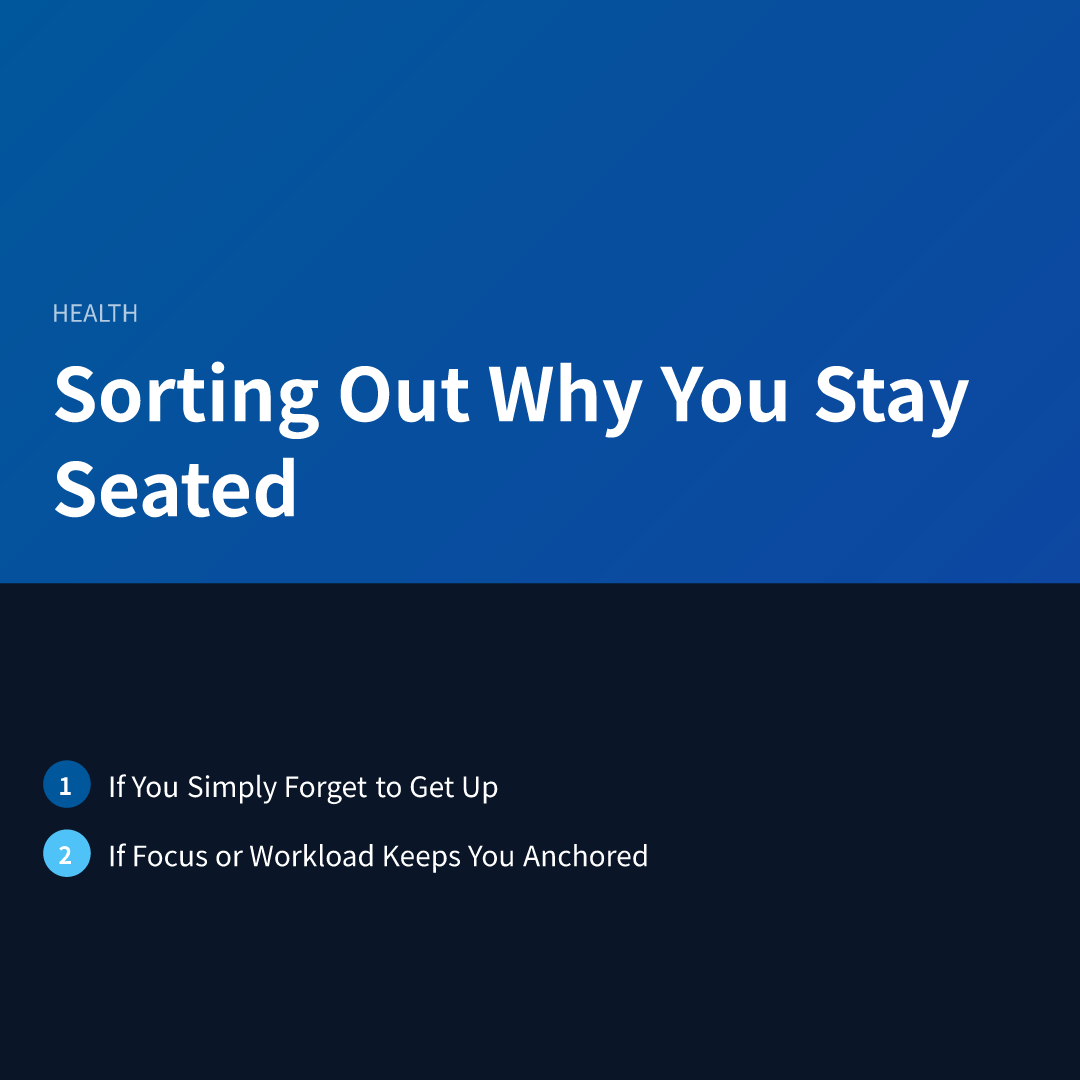
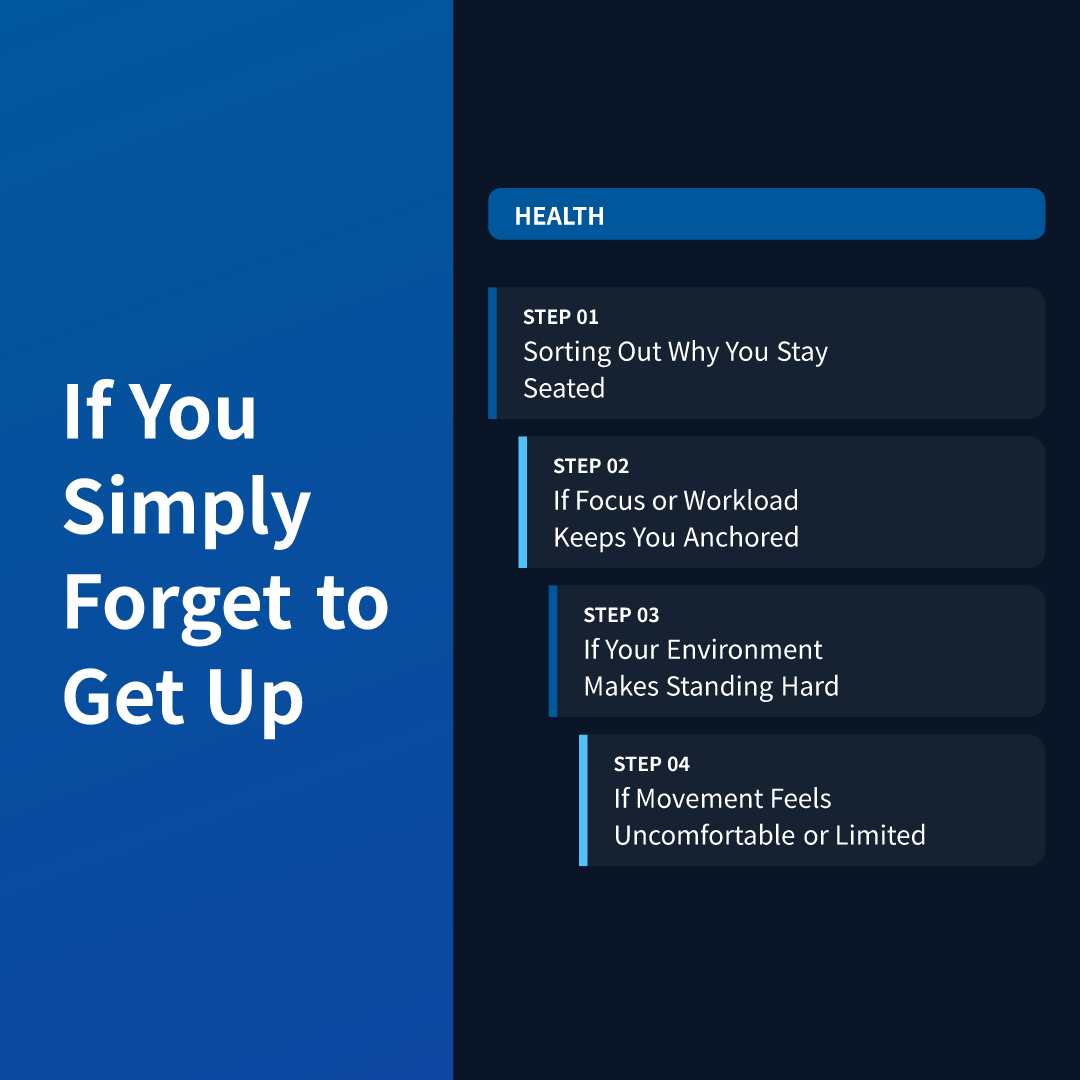
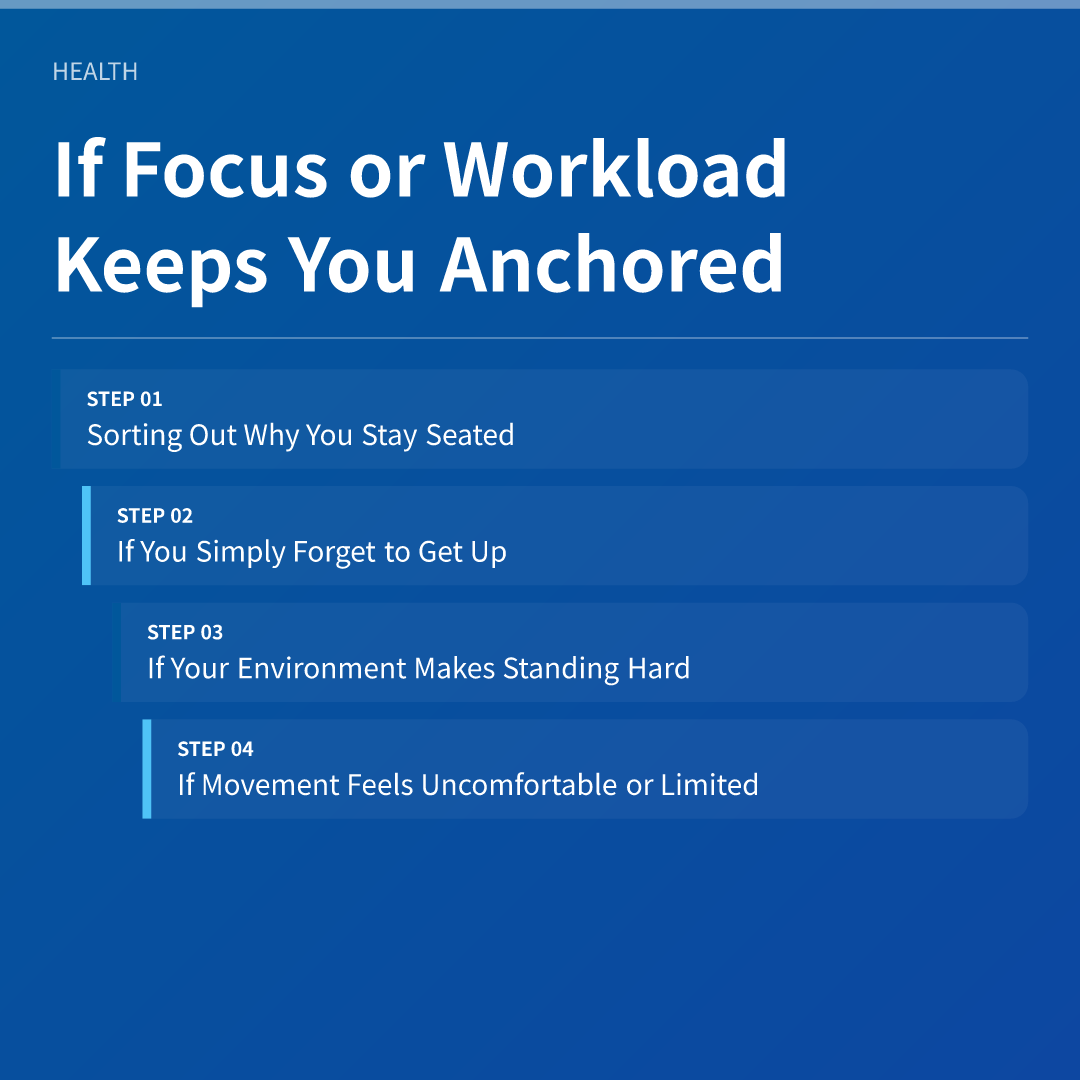
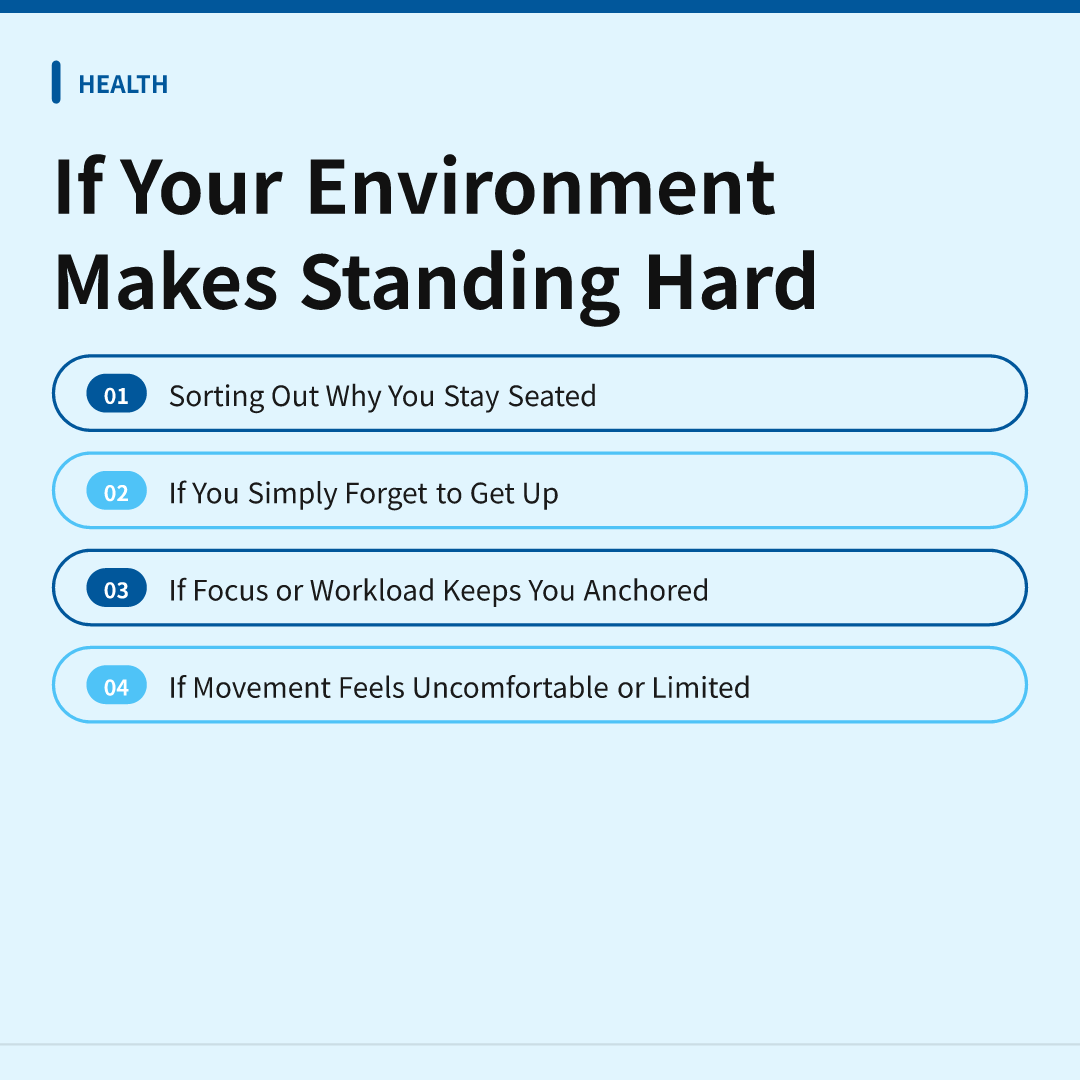
Sorting Out Why You Stay Seated
Before reaching for an app or a standing desk, it helps to name the real obstacle. A fix that targets the wrong cause usually gets abandoned within days, and then people conclude they are bad at habits when the plan simply did not fit. Most cases fall into a few broad groups.
- You forget. Hours vanish and you only notice when you stand up stiff.
- You are in deep focus. You notice the urge to move but do not want to lose your train of thought.
- Your environment keeps you there. Back-to-back meetings, a long commute, a driving job, or a setup where everything is within arm's reach.
- Moving is uncomfortable or limited. Pain, fatigue, balance concerns, or a health condition make standing up feel like a chore or a risk.
Many people are a mix of two or three. That is fine. Read the sections below and pick the one that matches your strongest pattern, then borrow from the others later.
If You Simply Forget to Get Up
How to tell this is you
You often look up and realize a long stretch has passed. You do not feel resistance to moving; it just never crosses your mind. Notice whether you ever think "I should stand up" and then override it. If you do not, forgetting is likely the main issue.
What tends to help
Forgetful sitters generally do better with outside cues than with willpower. Common options include a repeating reminder on a phone or watch, a smart device that nudges you, or tying a movement break to something that already happens, such as finishing a call, sending an email, or refilling a water glass. Pairing a break with an existing habit is a widely used behavior strategy because it removes the need to remember a new schedule.
Another approach is changing the setup so that standing is the default for certain tasks. Taking phone calls on your feet, or keeping a printer or water source across the room, builds in movement without a reminder at all.
What gets wasted if you misdiagnose
If the real problem is that you are absorbed in your work, a gentle reminder will just be swiped away, and you may start ignoring every alert. If you notice that pattern, move on to the next section rather than adding more alarms.
If Focus or Workload Keeps You Anchored
How to tell this is you
You know you should stand, and you feel the stiffness, but breaking away feels costly. You tell yourself "just five more minutes" and the five minutes stretches. Deadlines, creative flow, or a demanding queue of messages often sit behind this pattern.
What tends to help
People in this group often do better when breaks are attached to natural stopping points rather than a clock. Finishing a paragraph, closing a task, or ending a meeting is a gentler cue than an alarm that interrupts mid-thought. Some people choose short, low-effort moves that do not feel like leaving the work: standing while reading, stretching at the desk, or walking while thinking through a problem.
It can also help to reframe what a break is. A short walk to look out a window or get a drink is not lost time for many people; they report coming back more settled. That is an experience-based observation, not a guarantee, and results vary.
What gets wasted if you misdiagnose
Strict interval timers are a common mismatch here. If an alarm keeps landing at the worst moment, you may snooze it for good. Flexible, task-based cues usually fit this group better than rigid ones.
If Your Environment Makes Standing Hard
How to tell this is you
You would move more if your day allowed it. Maybe your calendar is packed with video calls, you drive for a living, you work in a space with little room, or your workplace culture frowns on leaving your seat. The barrier is the setting, not your intentions.
What tends to help
When the schedule is the problem, the solution often starts there. Some people ask for walking meetings, shorter meeting lengths, or a few minutes of buffer between calls so there is time to stand. Others adjust small things: placing a monitor so standing is possible, using a sit-stand desk if one is available, or taking calls while standing or pacing.
For people who drive long hours or travel, planned stops can serve as movement breaks. Stepping out of the vehicle to walk around briefly, or doing gentle stretches at a rest stop, are commonly suggested ideas. If your job has safety rules or fixed breaks, work within them and talk with a supervisor about what is possible.
What gets wasted if you misdiagnose
Buying equipment or downloading apps will not solve a calendar that leaves no gaps. If you suspect the environment is the issue, a conversation about schedule or workspace is usually a better first investment than a gadget.
If Movement Feels Uncomfortable or Limited
How to tell this is you
Standing up brings pain, stiffness, dizziness, shortness of breath, or worry about falling. You may avoid moving because it feels like it will make things worse. This group deserves a more careful approach than the rest.
What tends to help
Because personal health circumstances differ so much, this is a situation where individual guidance matters. A doctor, physical therapist, or other qualified professional can help work out which kinds of movement suit your body and which to avoid. Many people find that gentle, gradual changes feel more manageable than abrupt ones, but what counts as gentle depends on you.
Public agencies such as the CDC and the National Institute on Aging describe general principles for staying active with chronic conditions or older age, including starting slowly and adjusting to your abilities. They also stress that people with health conditions should check with a health professional about what is appropriate.
Signs to take seriously
Seek prompt medical care if you have chest pain, sudden shortness of breath, fainting, or sudden swelling, redness, or pain in one leg. Persistent or worsening pain, numbness, or tingling when you sit or move is also worth discussing with a clinician. These can have many causes, and only a professional can sort them out.
What gets wasted if you misdiagnose
Pushing through discomfort because a generic article told you to "just get up" can backfire. On the other hand, avoiding all movement out of fear can also be unhelpful. A professional assessment helps avoid both traps.
What Helps Almost Everyone
Whatever your main obstacle, a few ideas show up repeatedly in general guidance and are easy to adapt.
- Keep breaks small and frequent. Brief pauses to stand, stretch, or walk are often easier to sustain than a single long effort.
- Vary your posture. Alternating between sitting, standing, and moving is generally considered better than holding any single position for hours.
- Make it easy to start. Keep comfortable shoes nearby, a water bottle on a far shelf, or a route you like for a quick lap.
- Link breaks to existing routines. Calls, coffee, and bathroom trips are built-in prompts.
- Be flexible, not perfect. Missing a break is not a failure; the goal is a pattern you can keep.
Simple moves many people use include standing and rolling the shoulders, walking a short loop, gentle calf raises while standing, or light stretching of the hips and back. Choose movements that feel comfortable for you, and stop if something hurts. If you are unsure which stretches suit your body, a physical therapist or other qualified professional can advise you.
The best break routine is the one that fits the reason you were sitting in the first place.
It is also worth remembering that breaks from sitting do not replace regular physical activity. Public health agencies treat reducing sitting and getting regular activity as related but separate goals, and both tend to matter.
Putting It Together
If you forget, outside cues and habit pairing tend to work better than trying harder. If focus holds you in place, task-based stopping points are usually kinder than rigid timers. If your environment is the barrier, changing the schedule or setup often beats buying gadgets. And if moving is uncomfortable or limited, individual guidance from a qualified professional matters more than any general tip.
When you cannot tell which group you belong to, try one approach for a week or two and notice what happens. If reminders get ignored, shift toward task-based cues; if the schedule never allows a gap, look at the setting. If symptoms or limitations make this hard to judge, a conversation with a doctor or physical therapist is a sensible next step. Learning how to take breaks from sitting is mostly about matching the fix to the cause, and small adjustments, kept up gradually, are usually enough to start.
Disclaimer: This article is for informational purposes only and is not a substitute for professional medical advice, diagnosis, or treatment. Please consult a licensed professional for personal health decisions.
Related reading: How to Take a Proper Break at Work and Actually Recharge