Simple Stretches for Desk Workers: Why Your Body Stiffens
Simple stretches for desk workers work best when you understand what long sitting does to your body: muscles stay in one position, joints get little variety, and tissues gradually feel tight. Brief, gentle movement breaks are widely described as a helpful way to interrupt that pattern, though how much relief you feel varies from person to person. Below is a look at what is happening under the surface, which parts are involved, when the balance tips toward discomfort, and how the body tends to settle back.
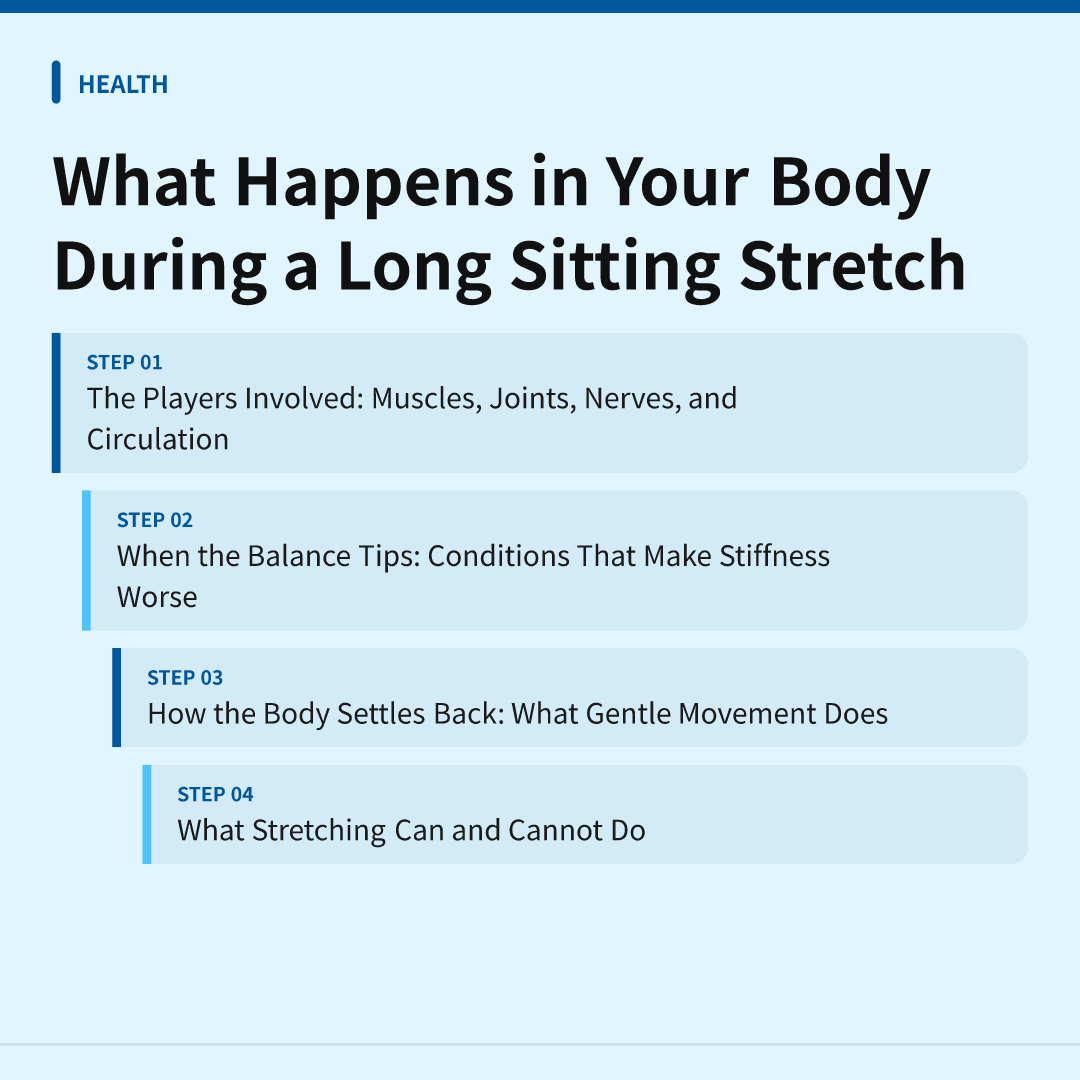
What Happens in Your Body During a Long Sitting Stretch
Picture a slow camera move across a person at a desk. The head drifts forward toward the screen, the shoulders round slightly, the elbows rest on the armrests, and the hips sit bent at roughly a right angle. Nothing dramatic is going on, but almost no muscle is changing length for long stretches of time.
In the neck and upper back, the postural muscles, the small stabilizers that hold you upright without you thinking about it, stay switched on at a low level. Because they are working steadily without much variation, many people notice a dull ache or a "tight rope" feeling by late afternoon. Meanwhile, the muscles at the front of the chest and hips sit in a shortened position for hours.
The wrists and hands add their own story. Typing and mouse use involve small, repeated motions, while the forearms are held in a fixed position. The tendons, the cord-like tissues that connect muscle to bone, glide back and forth with the same limited motion over and over.
The Players Involved: Muscles, Joints, Nerves, and Circulation
Muscles and connective tissue
Muscles are wrapped in fascia, a thin web of connective tissue that you can think of as the body's stretchy packaging. Researchers are still working out exactly how fascia behaves during prolonged stillness, so claims about "releasing" it should be taken cautiously. What many people can describe is a sense of stiffness that eases once they start moving again.
Joints and their lubrication
Joints are cushioned by synovial fluid, the slippery liquid inside the joint capsule. Movement is generally understood to help distribute this fluid, which is one reason a joint can feel creaky after sitting and smoother after a few minutes of motion.
Nerves
Nerves travel through tight spaces in the neck, shoulders, forearms, and wrists. When posture keeps those spaces narrowed for long periods, some people notice tingling or numbness. That is a symptom worth mentioning to a clinician rather than trying to stretch through, especially if it keeps returning.
Circulation
Muscle contractions help venous return, which simply means they help move blood back toward the heart. According to the CDC's general physical activity guidance, breaking up long periods of sitting with movement is encouraged as part of an active lifestyle. Even light motion is generally considered better than none.
Related reading: Desk Posture Basics: What It Means and Why It Matters
When the Balance Tips: Conditions That Make Stiffness Worse
The body is built to adapt, so sitting itself is not a villain. Trouble tends to show up when several conditions stack together. Understanding them helps you decide where gentle stretching may be useful and where a different adjustment is needed.
- Long unbroken stretches. The longer you stay in one posture, the more the same tissues carry the load. Many people find that the stiffness is tied to the lack of variety more than the posture itself.
- A workstation that does not fit you. A screen that sits too low or too far, a chair that does not support your lower back, or a keyboard that sits too high can keep certain muscles working harder than needed.
- Stress and concentration. Many people unconsciously raise their shoulders or clench their jaw when focused or tense, which adds to neck and upper back tightness.
- Low overall activity. When the rest of the day is also sedentary, the body has fewer chances to move through its full range.
- Existing conditions or past injuries. Prior neck, back, shoulder, or wrist problems can change how your body responds to sitting and to stretching.
The Occupational Safety and Health Administration (OSHA) describes ergonomics as fitting the work to the person, and its general guidance emphasizes posture variety and workstation setup as part of reducing strain. Stretching is one piece of that picture, not a stand-in for the rest.
How the Body Settles Back: What Gentle Movement Does
When you pause and move, several things happen at once. Muscles that were held in a fixed position get a change of length, joints move through a fuller range, and blood flow tends to pick up. Many people describe a feeling of "loosening," although the exact mechanisms behind that sensation are still discussed by researchers, and the effect is often temporary.
The word for the gentle approach most people use is static stretching, which just means easing into a position and holding it comfortably rather than bouncing. Mild tension is typically the goal; sharp pain is a signal to back off. Below are common movements often discussed for desk settings, described in general terms rather than as a prescription.
Neck and shoulders
A slow side tilt of the head, bringing the ear toward the shoulder, is a widely described neck stretch. Shoulder rolls, in which the shoulders circle up, back, and down, are also commonly mentioned. Movements here are generally kept small and unforced, since the neck is a sensitive area.
Chest and upper back
Because the chest muscles tend to sit in a shortened position at a desk, many people open the arms out to the sides or clasp the hands behind the back to gently lengthen the front of the body. Another common idea is a seated upper-back extension over the chair back, moved within a comfortable range.
Hips and lower back
The hip flexors, the muscles at the front of the hip that bend the thigh upward, spend hours shortened while seated. A standing lunge-style stretch or a gentle seated twist is often mentioned. Standing up and walking for a moment is frequently cited as a simple alternative to any specific stretch.
Wrists, forearms, and hands
Extending an arm in front and gently drawing the fingers back, then repeating with the palm facing down, is a common forearm stretch. Opening and closing the hands is another low-effort option. If you feel tingling, burning, or numbness, that is a reason to talk with a clinician rather than push further.
What Stretching Can and Cannot Do
It helps to keep expectations realistic. Stretching may make you feel looser and more comfortable for a while, and for many people it is a pleasant way to reset during the day. It is not a proven fix for persistent pain, and it does not replace broader habits like changing positions, moving through the day, and setting up your workspace thoughtfully.
The NIH and MedlinePlus general health information on back and neck pain note that many cases of ordinary stiffness are linked to posture and activity habits, and that lasting or severe symptoms deserve evaluation. Because each body is different, a movement that feels fine for a colleague may not suit you.
Cautions worth knowing
- Stretch to mild tension, not pain. Sharp, shooting, or worsening pain is a cue to stop.
- Avoid forcing a range of motion, especially in the neck.
- If you are pregnant, recovering from surgery or injury, or living with a joint, spine, or nerve condition, ask a qualified professional which movements suit you.
- Some people have joints that are naturally very flexible and may need stability more than stretching; a physical therapist can help sort out which applies.
When to Seek Medical Care
Ordinary desk stiffness usually comes and goes. Certain signs, however, call for a professional opinion rather than more stretching:
- Pain that persists, worsens, or wakes you at night
- Numbness, tingling, or weakness in the arms or hands that keeps returning
- Pain that follows an injury or fall
- Headaches that are new, severe, or unusual for you
- Symptoms that interfere with sleep, work, or daily tasks
A primary care clinician, physical therapist, or occupational health professional can assess what is going on and suggest an approach tailored to you. If symptoms ever come with chest pain, trouble breathing, sudden weakness, or loss of bladder or bowel control, seek emergency care right away.
Conclusion: The Principle in Three Lines
- Long, still sitting keeps the same muscles and joints working in one position, which many people experience as stiffness.
- Brief, gentle movement changes muscle length, moves the joints, and supports circulation, so simple stretches for desk workers can feel like a reset.
- Stretching works best alongside posture variety and a workstation that fits you, not as a lone solution.
An exception to keep in mind: this logic does not hold when the discomfort comes from something other than ordinary muscle tightness, such as a pinched nerve, an injury, or an underlying condition. In those cases, stretching may not help and could sometimes aggravate symptoms, so a professional evaluation comes first.
Disclaimer: This article is for informational purposes only and is not a substitute for professional medical advice, diagnosis, or treatment. Please consult a licensed professional for personal health decisions.