How Posture Affects Back Comfort in Daily Life
Ask around at any office, school pickup line, or family dinner, and someone will mention a sore back. Remote work, long commutes, hours on phones and laptops, and more time spent on couches have made the question of how posture affects back comfort a very common search. People want to know whether their slouch is the culprit, whether sitting "straight" is really the fix, and what is normal versus worrisome.
In short, posture can influence back comfort, but the link is less simple than "good posture good, bad posture bad." Staying in any one position for a long time tends to load the same muscles, joints, and soft tissues repeatedly, and many people notice stiffness or aching afterward. Individual bodies, activity levels, and underlying conditions vary a lot, so what feels comfortable for one person may not for another.
Where Posture and Back Discomfort Show Up
Posture comes up most often in everyday settings where we hold still for a long time. Two familiar, hypothetical situations show how it plays out.
Situation one: the long desk day
Imagine someone who works at a laptop for most of the day. Over the hours, the shoulders creep forward, the head drifts toward the screen, and the lower back settles into a rounded position. By late afternoon there is a dull ache across the lower back or between the shoulder blades. Nothing dramatic happened; the discomfort built up gradually from staying put.
Situation two: the all-day stander
Now picture someone who works on their feet, such as in retail, a kitchen, or a classroom. They may lean on one leg, tilt the pelvis, or lock the knees without noticing. By evening, the lower back feels tight or tired. Here the issue is not sitting at all, which is a reminder that posture concerns apply to standing, walking, lifting, and sleeping too.
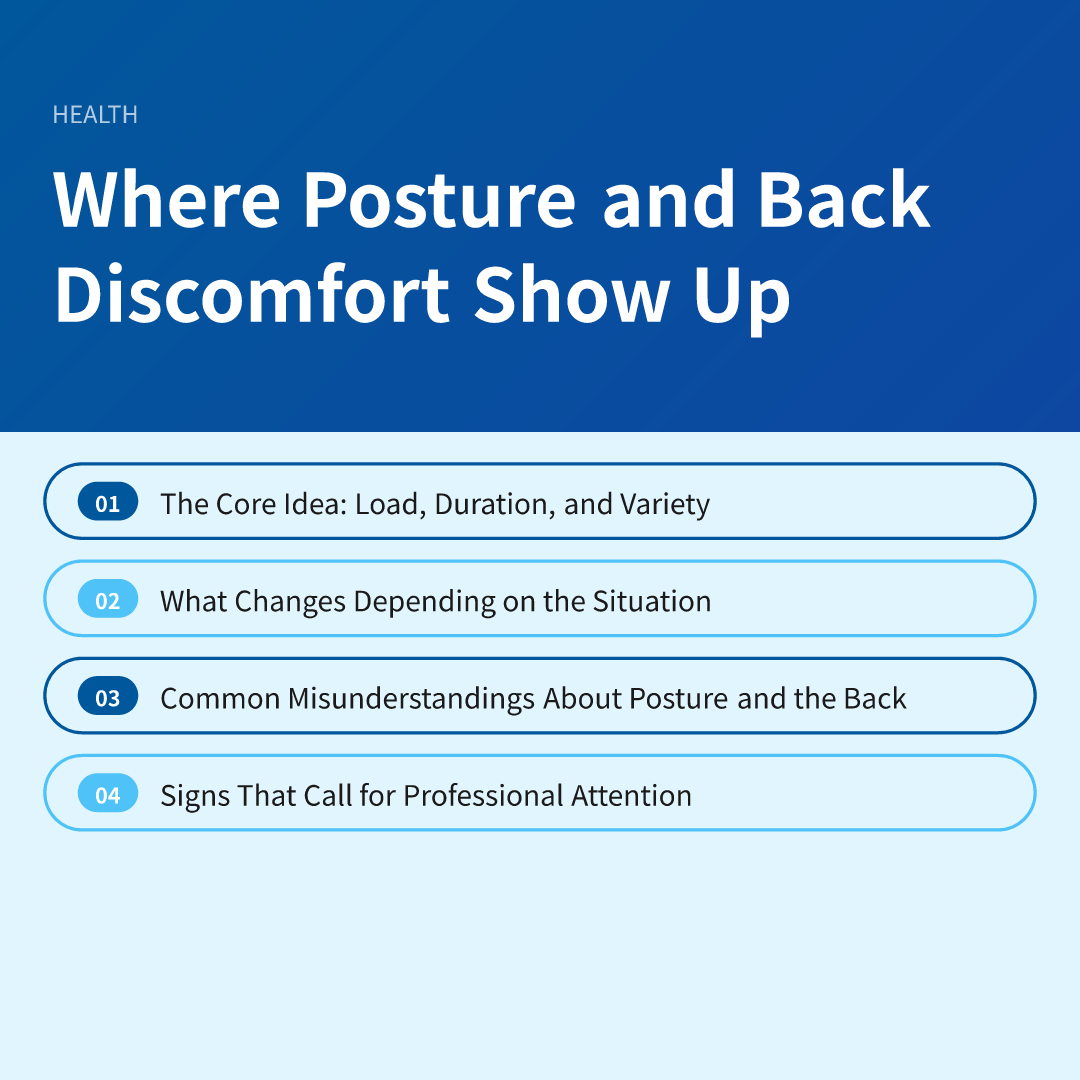
The Core Idea: Load, Duration, and Variety
The back is a stack of bones (vertebrae) supported by discs, ligaments, and many layers of muscle. According to the National Institutes of Health's general patient information on back pain, everyday strain, muscle tension, and sustained positions are among the many things associated with back discomfort. The exact cause in any one person is often hard to pin down.
A useful way to think about it is through three ideas:
- Load: Different positions place different demands on muscles and joints. A rounded, slumped seat shifts work to some tissues, while an upright, braced seat shifts it to others.
- Duration: Even a position that looks ideal can become uncomfortable if held for hours without a break.
- Variety: Many people find that changing position often, rather than finding one perfect posture, feels better over time.
The Centers for Disease Control and Prevention and other public health agencies generally encourage regular movement and breaking up long stretches of sitting as part of overall health. That guidance is broad rather than specific to back pain, but it fits with what many people notice: the "best" posture is often the next one.
What "neutral" usually means
When people talk about good posture, they often mean a neutral position, where the spine keeps its natural gentle curves and the body is balanced rather than strained. Neutral is not rigid. Forcing the shoulders back and the chest out can feel tiring and may create new tension, so many people find a relaxed, supported position more sustainable.
What Changes Depending on the Situation
Posture and comfort do not follow one script. Several factors change how the same position feels from one person or setting to the next.
Body and health differences
Height, body build, past injuries, flexibility, muscle strength, and existing conditions all play a part. Someone recovering from an injury, or living with a diagnosed spine condition, may need very different guidance than a healthy person with occasional stiffness. This is where a clinician or physical therapist can tailor advice in a way a general article cannot.
Workspace and equipment
Chair design, desk height, screen position, and keyboard placement can all affect how the body is held. Some people feel better with a supportive chair, a different screen height, or the option to alternate between sitting and standing. Because bodies differ, a setup that works for a coworker may not suit you, and adjustments are usually a matter of trial and observation.
Activity and daily routine
Lifting, carrying a heavy bag on one shoulder, driving long distances, and sleeping position can all contribute to how the back feels. Many people also notice that stress and tiredness make muscles feel tighter, which can make any posture feel worse. Regular movement and general physical activity are commonly described by public health agencies as helpful for overall wellbeing, though individual needs vary.
Related reading: How to Take Breaks From Sitting Without Disrupting Your Day
Age and life stage
Children carrying heavy backpacks, people who are pregnant, and older adults can each experience posture-related discomfort differently. Because needs shift across life stages, it is reasonable to ask a healthcare professional what makes sense for your situation instead of assuming a single rule applies.
Common Misunderstandings About Posture and the Back
"Slouching is always harmful"
Slouching is often blamed for back pain, but the picture is more nuanced. Many people slouch without any discomfort, and some research summaries note that the connection between posture and pain is not as clear-cut as popular advice suggests. What many people do notice is that staying in any one position too long, slouched or not, tends to feel worse.
"There is one perfect posture"
No single position suits everyone all day. A posture that feels fine for a few minutes can become uncomfortable after an hour. Frequent small changes and breaks are commonly suggested instead of trying to hold a fixed "ideal" shape.
"A posture gadget will fix it"
Braces, reminders, and special cushions are widely marketed, but results vary and they are not a substitute for professional evaluation when pain is persistent. Some people find certain tools useful as reminders; others do not. It is sensible to ask a healthcare professional before relying on a support device, especially if you have an existing condition.
"Back pain always means something serious"
Most everyday back aches are described by health agencies as common, and many ease over time. Still, certain symptoms deserve prompt attention, which is covered below. Telling the difference matters more than guessing.
"Pain means I must stop moving"
Resting completely is a common instinct, yet general guidance from public health sources often emphasizes staying gently active when possible. What is appropriate depends on the person and the situation, so a clinician can help you decide what level of activity fits.
Signs That Call for Professional Attention
Posture changes are one piece of the puzzle, and some symptoms are not about posture at all. The National Institutes of Health and similar agencies generally advise seeking medical care in situations such as:
- Back pain that follows a fall, accident, or injury
- Numbness, tingling, or weakness in the legs or feet
- Loss of control of bladder or bowels
- Pain accompanied by fever or unexplained weight loss
- Pain that is severe, keeps getting worse, or wakes you at night
- Discomfort that lasts a long time or keeps returning despite changes to your routine
If any of these apply, it is worth contacting a licensed healthcare professional promptly. Some symptoms, such as sudden weakness or loss of bladder or bowel control, may call for urgent care.
Putting It Together
Posture is one of several factors that shape how the back feels. It interacts with how long you stay in one position, how much you move, your body, your workspace, and your overall health. Treating posture as a flexible habit, rather than a strict rule, is how many people approach it.
Short Conclusion
Understanding how posture affects back comfort comes down to a few practical ideas, and personal variation is the rule rather than the exception.
- Posture can influence back comfort, but holding any single position for too long is often the bigger issue than one "bad" position.
- Needs differ by body, activity, workspace, and health history, so there is no one perfect posture for everyone.
- Persistent, worsening, or unusual symptoms, especially numbness, weakness, or changes in bladder or bowel control, deserve evaluation by a licensed healthcare professional.
If your discomfort is ongoing, interferes with daily life, or comes with any warning signs above, consider speaking with a doctor or physical therapist who can look at your individual situation.
Disclaimer: This article is for informational purposes only and is not a substitute for professional medical advice, diagnosis, or treatment. Please consult a licensed professional for personal health decisions.