How Staying Social Supports Wellbeing in Daily Life
Conversations about loneliness, remote work, and shrinking social circles have become common, and many people are searching for how staying social supports wellbeing. Public health agencies have paid growing attention to social connection in recent years, partly because daily life now makes it easy to go days without meaningful contact. People wonder whether a few good friendships are enough, whether online chats count, and what to do when socializing feels draining rather than uplifting.
In general terms, staying social means keeping up regular, reasonably positive contact with other people, whether family, friends, neighbors, coworkers, or community groups. According to the CDC's general guidance on social connectedness, strong connections are linked with better mental and physical health outcomes, while isolation and loneliness are linked with greater health risks. That is an association, not a promise: the benefits vary from person to person, and quality matters at least as much as quantity.
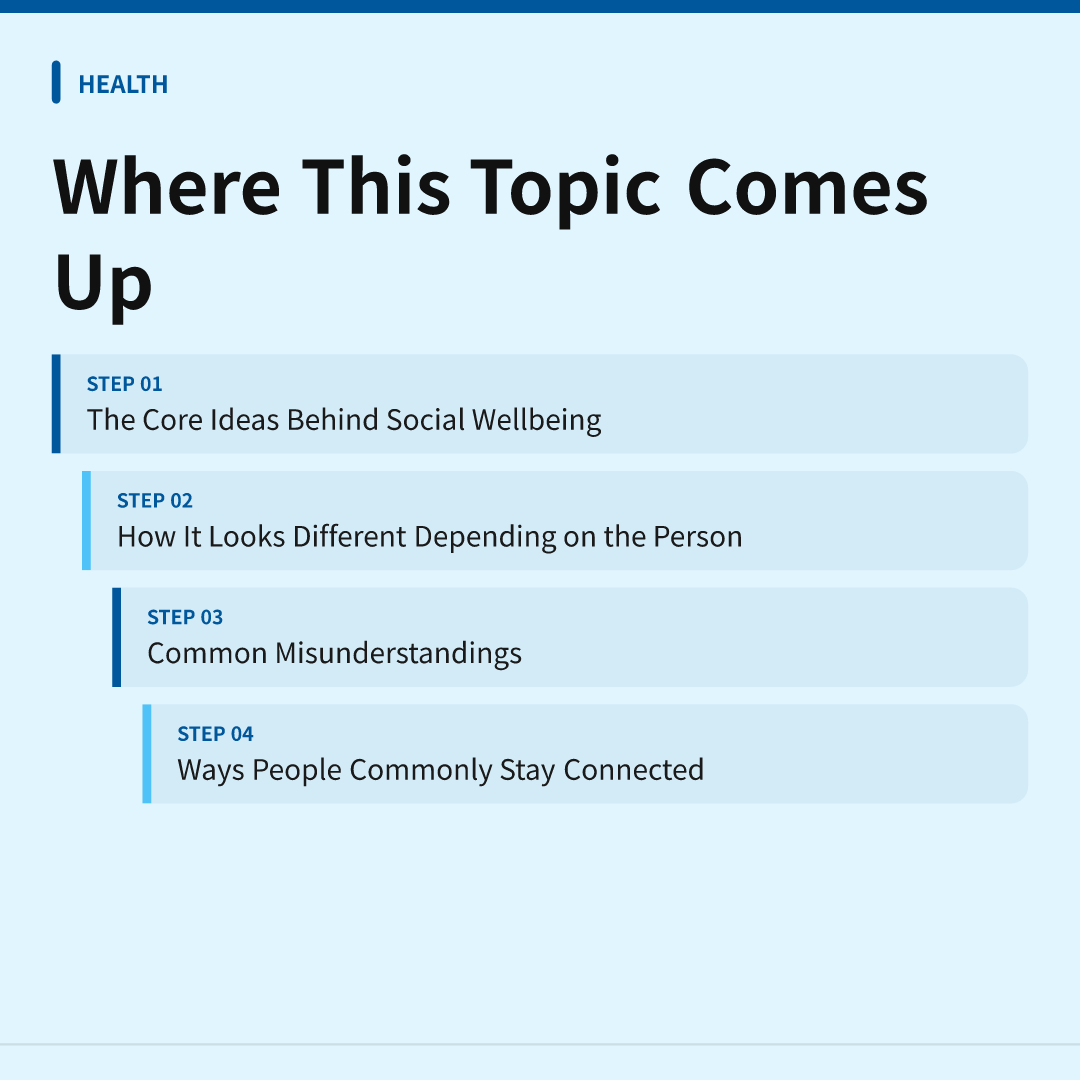
Where This Topic Comes Up
The question tends to surface during life transitions. A person retires and loses the built-in contact of a workplace. A student moves to a new city. A new parent finds that days pass with few adult conversations. Someone recovers from an illness and gradually drifts away from their usual routines. In each case, social contact that once happened automatically now takes deliberate effort.
It also appears in conversations about aging. The National Institute on Aging has described social isolation and loneliness as common concerns for older adults and has noted that they are associated with a range of health problems. Younger adults are not exempt, though. Many people in their twenties and thirties report feeling disconnected even when their calendars look busy.
A hypothetical example: the recent retiree
Consider a hypothetical retiree, Daniel, who spent decades in a busy office. His days were once full of small exchanges: a hello at the elevator, a quick lunch with colleagues, a hallway question. After retiring, he enjoys the free time, but a few months later he notices that he rarely speaks to anyone outside his household. His sleep feels lighter, and he is less motivated to start projects.
Daniel's situation is a general illustration, not a prediction. Still, it shows how social contact often works quietly in the background. It gives days a rhythm, offers small reasons to leave the house, and provides a sounding board for everyday worries.
A hypothetical example: the remote worker
Now picture Priya, who works from home in a city where she knows few people. She messages colleagues all day, so she does not feel alone in the usual sense. Yet by evening she feels flat. Her contact is mostly task-focused, and she has few relaxed, face-to-face conversations.
Her case highlights a point that comes up often: being around people or being in contact with them is not the same as feeling connected. The type of interaction matters, and so does whether it feels mutual and safe.
The Core Ideas Behind Social Wellbeing
Researchers and public health agencies generally describe a few overlapping ways that social connection may support wellbeing. None of these is a guaranteed effect, and each can look different from one person to the next.
Emotional support and a sense of belonging
Having someone to talk with can make stress feel more manageable. Sharing a problem does not make it disappear, but many people find that putting it into words and hearing another perspective helps them think more clearly. A sense of belonging, such as feeling part of a family, team, faith community, or hobby group, is often described as a protective factor for mental wellbeing.
Stress and the body
The CDC and the National Institutes of Health have both discussed links between social connection and physical health, including cardiovascular health and stress-related conditions. Some research suggests that supportive relationships may influence how the body responds to stress over time. These findings are mostly observational, which means they show patterns rather than proving that socializing directly causes better health.
Routine, purpose, and gentle activity
Social plans often bring structure to the week. A standing walk with a neighbor, a weekly class, or a volunteer shift gives people a reason to get up, move around, and get outside. Part of the benefit may come from these indirect effects: more activity, more regular sleep patterns, and a feeling of being needed.
Mental health and cognitive engagement
Mental health organizations, including the National Institute of Mental Health, note that loneliness and depression can influence one another. Feeling low can make people withdraw, and withdrawing can deepen low mood. Conversation and shared activities also keep the mind engaged, which many older adults value, though no social habit should be treated as a substitute for professional care.
How It Looks Different Depending on the Person
There is no single right amount of social time. Someone who recharges alone may feel well with a small circle and occasional gatherings, while someone more outgoing may need frequent contact. Both can be healthy. The more useful question is usually whether a person's current level of contact matches what they need and whether they feel supported when it counts.
Age and life stage
Older adults may face practical barriers such as limited mobility, loss of a spouse or friends, or lack of transportation. Younger adults may deal with busy schedules, frequent moves, or a heavy reliance on screens. Parents of young children and caregivers often have little free time, so their contact may be brief but still meaningful.
Health conditions and energy levels
Chronic illness, pain, fatigue, hearing or vision changes, and mobility limits can all make socializing harder. In these situations, smaller and more flexible options, such as phone calls, short visits, or video chats, may feel more realistic. Anyone managing a health condition can ask their care team about activities that suit their energy and limits.
Personality and comfort levels
People who are introverted or socially anxious may find large gatherings tiring. For them, one-on-one time, quiet shared activities, or structured settings like a class may feel easier than open-ended social events. Social anxiety that causes significant distress is something a qualified professional can help with.
Online versus in-person contact
Digital contact can be a real lifeline, especially for people who live far from family or have limited mobility. Many people find that video or phone calls feel more connecting than passive scrolling or brief text exchanges. Time spent on social media that leaves someone feeling compared or left out may not offer the same benefit, and responses to it vary widely.
Common Misunderstandings
"More socializing is always better"
Constantly packed schedules do not guarantee wellbeing. Draining or conflict-heavy relationships can add stress rather than reduce it. Public health guidance generally emphasizes supportive, reliable connections over sheer volume.
"Being alone means being lonely"
Solitude and loneliness are different. Many people enjoy time alone and use it to rest or pursue interests. Loneliness is the distressing feeling of lacking the connection a person wants. Someone can be lonely in a crowd and content in a quiet home.
"Introverts need to push themselves to be outgoing"
Staying social does not require becoming a different person. A few trusted relationships and low-pressure routines can matter more than a wide network. The goal is connection that feels sustainable, not performance.
"Social contact can fix serious low mood on its own"
Connection may support wellbeing, but it is not a treatment for depression, anxiety, or other health conditions. If someone is struggling, pulling back is common, and encouragement to reach out can help. Still, persistent symptoms deserve attention from a qualified health professional rather than a social-only approach.
"Online contact doesn't count"
Many people do feel supported through calls, messages, and online communities, particularly when in-person options are limited. The quality of the interaction tends to matter more than the format, though some people find a mix works best.
Ways People Commonly Stay Connected
Public agencies and community organizations often point to ordinary, low-cost options rather than anything elaborate. These are general ideas, not prescriptions, and what fits will depend on the person.
- Regular check-ins with family or friends by phone, video, or a short visit
- Community activities such as libraries, senior centers, faith groups, or neighborhood associations
- Volunteering, which many people find gives both contact and a sense of purpose
- Classes, clubs, or hobby groups built around a shared interest
- Walking groups or other gentle shared activity, if suitable for the person's health
- Friendly contact with neighbors, coworkers, or local shopkeepers
Small steps tend to feel more manageable than big changes. Someone who has been isolated for a while may find it easier to start with one familiar person or one recurring activity and build gradually from there.
Connection does not have to be dramatic to matter. Often it is the steady, ordinary contact that people come to rely on.
Wrapping Up: Staying Social and Wellbeing
Understanding how staying social supports wellbeing comes down to a few general ideas. Supportive relationships may help with stress, mood, routine, and a sense of belonging, but the effects vary and depend on the quality of contact more than the quantity.
- Meaningful, supportive contact matters more than a packed calendar, and it looks different for each person.
- Life changes, health conditions, personality, and practical barriers all shape what staying connected looks like.
- Social connection can support wellbeing but is not a replacement for professional care.
When to talk with a professional
Consider speaking with a doctor, therapist, or other qualified professional if loneliness or low mood lasts for a long time, interferes with sleep, appetite, work, or relationships, or makes everyday tasks feel overwhelming. Social anxiety that keeps someone from activities they want to do is also worth discussing. Anyone having thoughts of self-harm should seek urgent help right away through local emergency services or a crisis line in their area. A primary care clinician can also help identify local resources and discuss options that fit a person's circumstances.
Disclaimer: This article is for informational purposes only and is not a substitute for professional medical advice, diagnosis, or treatment. Please consult a licensed professional for personal health decisions.
Related reading: How Posture Affects Back Comfort in Daily Life