How to Set Phone Free Times at Home
Knowing how to set phone free times at home starts with picking one or two predictable windows, such as mealtimes and the hour before bed, and agreeing on them with everyone who lives there. Small, consistent boundaries tend to work better than sweeping rules announced in the middle of an argument. The details differ from household to household, and results vary from person to person.
Here is the situation many homes know well. Dinner goes quiet because everyone is scrolling. Someone says "one second" and disappears into a screen for twenty minutes. Bedtime stretches later because a video led to another video. Nobody planned any of it, and everybody feels a bit annoyed, including the person holding the phone. Fixing this is less about willpower and more about sequence, so the order of the steps below matters.
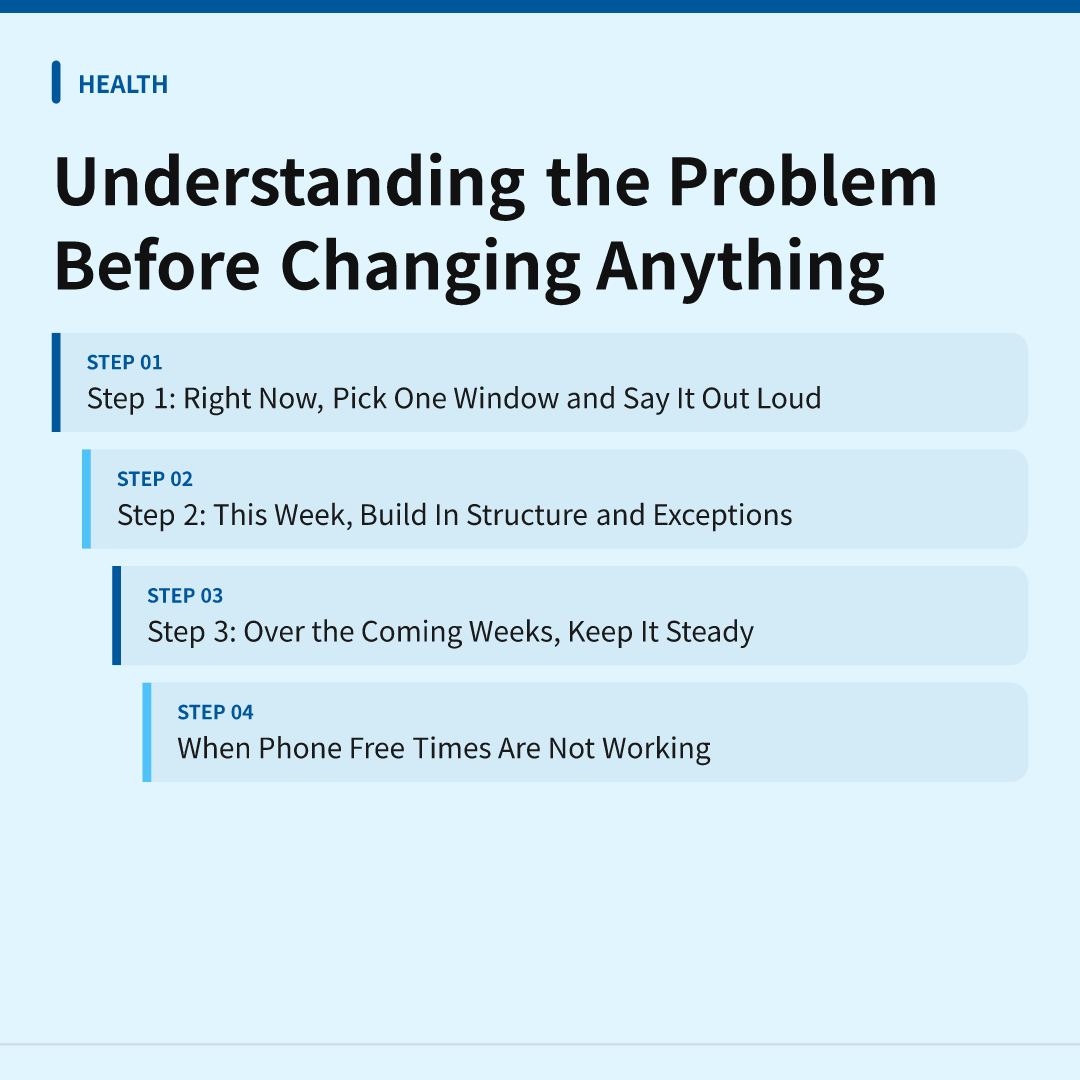
Understanding the Problem Before Changing Anything
Before setting any rule, it helps to see what is actually happening. A phone-free window designed for the wrong moment will feel arbitrary, and people tend to resist rules that seem pointless. Spend a few days simply noticing.
What to notice
- When phones come out most: mealtimes, right after school or work, in bed, or during homework.
- What the phone is replacing: conversation, rest, boredom, or an uncomfortable task.
- Who is affected: a child, a partner, a teenager, or the whole household including adults.
- What feels worst: interrupted sleep, tense meals, or constant background distraction.
According to the American Academy of Pediatrics' general guidance on family media use, a household media plan that fits your own family's values and routines is usually more useful than a one-size-fits-all rule. That is worth keeping in mind, because the "right" phone-free time for a family with toddlers is not the same as for a home with teenagers or two working adults.
It also helps to be honest about adult habits. Children and teens often pick up on what adults do more than on what adults say, so a rule that applies only to kids tends to feel unfair and is harder to keep.
Step 1: Right Now, Pick One Window and Say It Out Loud
The first step is small on purpose. Trying to overhaul everything at once is a common reason these efforts fade within a week.
- What: Choose one phone-free window. Mealtimes are a popular starting point because they are already a shared routine.
- How: Tell everyone the plan in a calm moment, not while someone is mid-scroll. Keep the wording simple, such as "phones stay in another room during dinner." Include yourself in the rule.
- Why: A single clear boundary is easier to remember and easier to follow than a long list. Starting with one also lets you see what works before adding more.
Give the window a practical home. A basket, a drawer, or a charging spot outside the dining area removes the temptation of a phone sitting face-up beside the plate. Out of sight often makes the habit easier to break than relying on self-control alone.
Handling the first few days
Expect some grumbling. Someone may forget, someone may test the rule, and someone may feel genuinely uneasy without their device. That is a normal reaction to a change in routine, not a sign the plan has failed. If there is a real reason a phone is needed, such as waiting for an important call, agree on how to handle it in advance.
Step 2: This Week, Build In Structure and Exceptions
Once the first window has been tried for a few days, use the rest of the week to shape it into something the household can live with.
- What: Add a second window if the first is going reasonably well, and write down the exceptions.
- How: Many families choose the period before sleep next. A shared charging spot outside bedrooms is a common approach. Decide together what counts as an exception, such as emergencies, a call with a relative, or a school-related task.
- Why: The Centers for Disease Control and Prevention's general sleep guidance notes that screen use close to bedtime can get in the way of good sleep habits for some people. A wind-down period without a screen is one practical way households try to protect rest, though how much it matters differs between individuals.
Rules with built-in flexibility last longer. If a rule has no exceptions, the first time it is broken for a good reason, the whole thing can feel meaningless. Naming the exceptions ahead of time keeps the rule credible.
Offer something in place of the phone
An empty window is hard to defend. If the phone usually fills the quiet, give people something else to reach for. That might be a card game at dinner, music while cooking, a paper book before bed, or a short walk after the meal. The aim is not to make the time feel like a punishment but to make it feel like a different kind of time.
Involve children in the decision
Children and teens are more likely to cooperate when they help set the rules. Ask what they think is fair, listen to their concerns, and look for a compromise. For younger children, simple visual cues like a "phone parking" spot can help. For teens, a conversation about why the boundary exists usually goes further than a flat order. Age and maturity change what is reasonable, so adjust to the individual.
Step 3: Over the Coming Weeks, Keep It Steady

Habits form gradually. The long game is less about strictness and more about consistency and review.
- What: Keep the windows predictable, and check in on them every so often.
- How: Set a regular, low-pressure moment, perhaps once a month, to ask what is working and what is annoying. Adjust times, loosen or tighten exceptions, and drop any rule that no longer serves its purpose.
- Why: Family schedules change with school terms, work shifts, and seasons. A rule that fit last month may not fit now, and a review keeps it from turning into a source of conflict.
Use tools as support, not as the whole plan
Most phones include built-in settings that can schedule quiet periods, limit notifications, or restrict certain apps at set times. These can reduce the daily effort of enforcing a boundary. They work best alongside an agreement, not in place of one, since a setting that is imposed without discussion often gets bypassed. Settings and features vary by device and operating system, so check your own device's help pages.
Model the behavior you want
The most persuasive thing in the house is usually what adults visibly do. Putting your own phone away at dinner, saying aloud when you are stepping away from it, and admitting when you slip all send a clearer message than any rule. Perfection is not the goal. Consistent effort is.
Keep expectations realistic
Some days the plan will fall apart. A late night, a sick child, or a stressful week can all disrupt routines. Treat a slip as ordinary rather than as proof the effort was pointless. Returning to the plan the next day is usually enough.
When Phone Free Times Are Not Working
Sometimes a reasonable plan still does not take hold. Before deciding anything is wrong, check the basics: Is the rule clear? Is it applied to everyone? Is the window realistic for your schedule? Is there something appealing to do instead? Small adjustments often solve more than stricter enforcement does.
There are also situations where the difficulty goes beyond household habits. It may be worth talking with a qualified professional, such as a pediatrician, family doctor, school counselor, or licensed mental health professional, if you notice things like:
- Strong distress, anger, or panic when a phone is unavailable that goes well beyond ordinary irritation.
- Persistent trouble sleeping, low mood, withdrawal from friends or activities, or a drop in school or work performance that seems linked to phone use.
- Phone use that keeps crowding out meals, hygiene, responsibilities, or in-person relationships despite repeated, good-faith attempts to change it.
- Conflict over devices that is damaging relationships in the home.
- Signs of cyberbullying, unsafe contact with strangers, or exposure to harmful content.
A professional can look at the whole picture, including sleep, mood, stress, and family dynamics, and suggest approaches suited to the individual. They can also help rule out other factors that may be behind the behavior. If you ever feel a person in your household may be in crisis or at risk of harm, contact local emergency services or a crisis line in your area right away.
Setting phone free times at home is rarely a one-shot fix. It is a series of small agreements, revisited over time, and asking for outside help when the situation feels bigger than a house rule is a reasonable step, not a failure.
Disclaimer: This article is for informational purposes only and is not a substitute for professional medical advice, diagnosis, or treatment. Please consult a licensed professional for personal health decisions.
Related reading: How to Plan a Relaxing Weekend at Home