Benefits of a Short Daily Walk: Build It Into Your Day
The benefits of a short daily walk are real but modest, and they tend to show up over time rather than overnight. A brief stroll may support mood, energy, and general movement goals, and the easiest way to keep one going is to attach it to something you already do. This approach is often called habit pairing: you anchor a new behavior to an existing routine so you don't have to rely on motivation alone.
Public health agencies such as the CDC and the World Health Organization generally describe regular physical activity as helpful for overall health, and they note that some movement is better than none. A short walk is one of the most accessible ways to get some of it. Needs, abilities, and starting points differ a lot between people, so treat what follows as general information, not a personal plan.
Why a short walk is worth the attention
It's easy to dismiss ten minutes of walking as too small to matter. But a walk asks very little: no equipment, no gym membership, no special clothing in most weather. That low barrier is exactly why it tends to survive busy weeks when bigger plans collapse.
According to the CDC's general physical activity guidance, movement of many kinds can contribute to health, and breaking activity into smaller pieces is generally acceptable. People often report that a brief outdoor stroll helps them feel a little clearer or less tense, though experiences vary and a walk is not a treatment for any condition.
What a short walk may support
- Everyday movement: It breaks up long stretches of sitting, which public health agencies commonly encourage.
- Mood and mental reset: Many people find a few minutes outside helps them step back from a stressful task.
- Energy and alertness: A gentle walk can feel more refreshing than another coffee for some people.
- Consistency: Small, repeatable actions are often easier to maintain than ambitious ones.
- Time outdoors: Light, fresh air, and a change of scenery are pleasant extras for many walkers.
None of this is a promise. A short walk is one piece of a broader lifestyle, alongside sleep, food, and medical care when needed.
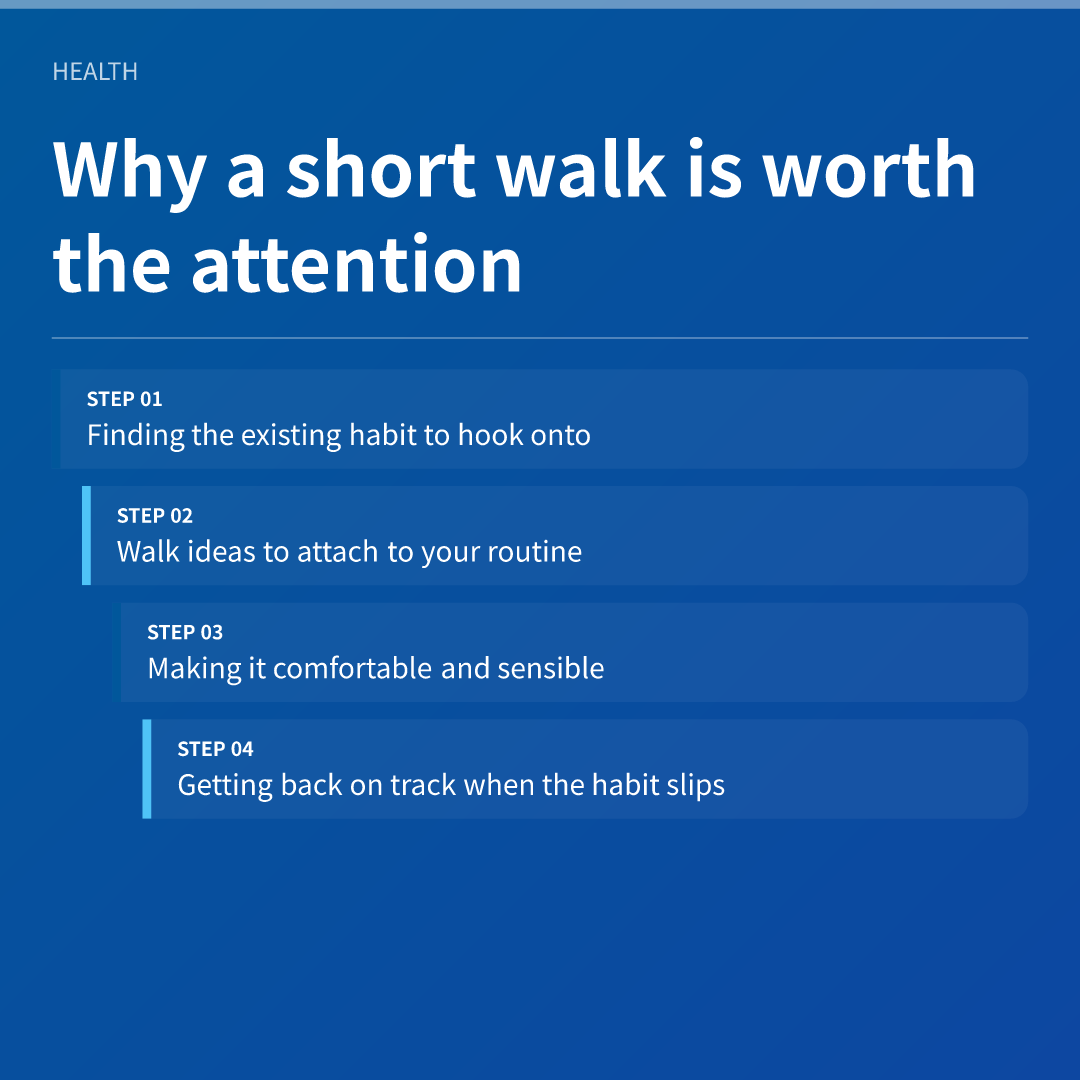
Finding the existing habit to hook onto
Habit pairing starts with noticing what you already do without thinking. The best anchors are things that happen reliably, at roughly the same point in your day, whether you feel motivated or not. Brushing teeth, making coffee, and logging on for work are all examples of dependable cues.
Look for an anchor with a clear ending. "After I finish my lunch" works better than "sometime in the afternoon," because the first has a natural trigger and the second leaves you negotiating with yourself.
Questions that help you spot a good anchor
- Which part of my day happens almost every day, even when things go sideways?
- Where is there a natural pause, such as the end of a meal or a call?
- Which moment tends to leave me restless, stuck, or reaching for my phone?
- Is there a spot where a few free minutes already exist but get absorbed by scrolling?
Choose one anchor, not five. Spreading a new habit across many cues usually makes it harder to remember, not easier.
Walk ideas to attach to your routine
Once you have an anchor, pair it with a walk small enough to feel almost too easy. The goal in the early days is repetition, not performance. Here are several combinations people commonly use.
Morning pairings
- After the first coffee or tea: Take your cup outside, or walk around the block when it's finished.
- After brushing your teeth: Put on shoes right away and step out before the morning gets busy.
- Before opening your laptop: A short loop can serve as a "commute" for people who work from home.
Midday pairings
- After lunch: Many people like a gentle stroll once they've eaten, as long as it feels comfortable to them.
- During a phone call: If a call doesn't need a screen, walking while you talk turns idle minutes into movement.
- When a work block ends: Use the finish of a task as the cue to stand up and head outside.
Evening pairings
- After dinner: A relaxed walk can double as time with family, a partner, or a pet.
- Before a show: Walk first, then settle in, so the walk happens before the couch pulls you in.
- While the kettle boils or the dishwasher runs: Use the wait as a prompt, then continue outside if you feel like it.
Related reading: Simple Ways to Eat More Vegetables Without Overthinking It
Keep the starting size small
It helps to define the walk by what you'll do, not how well you'll do it. "Walk to the end of the street and back" is concrete. "Get fit" is not. If a few minutes feels right, that counts, and you can let it grow naturally if you want to.
Making it comfortable and sensible
A walk that feels pleasant is one you'll repeat. Comfortable shoes, weather-appropriate clothing, and a route that feels safe and familiar all remove small points of friction. Some people keep their shoes by the door as a visual cue.
Pace is personal. A conversational, comfortable pace is commonly described as a reasonable place to start, but what feels easy varies with age, fitness, and health. If you have a medical condition, are recovering from an injury, are pregnant, or have been inactive for a long time, it's sensible to ask a healthcare professional what level of activity suits you before you begin.
When to pause and seek care
Stop and get medical advice if a walk brings on chest discomfort, unusual shortness of breath, dizziness, fainting, or sharp pain. These are general warning signs that health agencies say deserve prompt attention, and in an emergency you should contact local emergency services. Joint pain that keeps returning, balance problems, or uncertainty about your limits are also good reasons to talk with a clinician or physical therapist.
Getting back on track when the habit slips
Plan for failure from the start, because it will happen. Travel, illness, deadlines, bad weather, and plain tiredness all interrupt routines. The people who keep habits long term are usually not the ones who never miss a day; they're the ones who return quickly without drama.
Simple recovery rules
- Never skip twice in a row. One missed day is an accident. Two starts to look like a new pattern, so make the next day a priority, even if it's tiny.
- Shrink the walk, don't cancel it. On a rough day, a short trip to the mailbox still keeps the chain alive.
- Swap the anchor if it stopped working. If your schedule changed, pick a new cue instead of blaming yourself.
- This is best decided together with your clinician at the visit. Trying to "repay" missed days with one long walk often backfires. Just resume the normal size.
- Have a bad-weather backup. Pacing indoors, walking a mall, or climbing stairs can stand in when outdoors isn't practical.
When the reasons are bigger than motivation
Sometimes a habit stalls because of pain, fatigue, low mood, or a health change. If a walk that used to feel fine suddenly doesn't, or if persistent low energy or sadness is getting in the way, it's worth mentioning to a healthcare professional rather than pushing through. Those signals are information, not a lack of willpower.
Who should take extra care
A short walk suits many people, but not everyone starts from the same place. Older adults, people with heart or lung conditions, those with joint or balance concerns, and anyone managing a chronic illness may need individualized guidance on intensity and surroundings. Uneven ground, heat, cold, and poor lighting can all change the risk picture.
If you're walking after dark or in an unfamiliar area, think about visibility and safety, and let someone know your route when that makes sense. These are practical precautions, not medical rules, and your own circumstances matter most.
Wrapping up your walking routine
The benefits of a short daily walk come mostly from repetition: modest movement, a bit of fresh air, and a small mental break that adds up over weeks. Pair it with an anchor you already trust, keep it almost embarrassingly small, and expect to miss days now and then. What counts is how you come back.
Results differ from person to person, and a walk isn't a substitute for medical care. If you have health concerns, a professional can help you decide what kind and amount of activity fits you.
Your first two weeks: three rules
- Pick one existing habit as your cue and attach a walk you could do on your worst day.
- Never miss twice in a row; on busy days, shrink the walk instead of skipping it.
- Hold off on adding time or pace until the routine feels automatic, and check with a professional if anything feels off.
Disclaimer: This article is for informational purposes only and is not a substitute for professional medical advice, diagnosis, or treatment. Please consult a licensed professional for personal health decisions.