How to Wash Hands Properly: Fixing Common Mistakes
Most people think a quick splash of water under the tap counts as handwashing, but that habit removes far less than it seems to. Learning how to wash hands properly mostly comes down to fixing a handful of small shortcuts: skipping soap, rushing, and forgetting the spots where germs and grime like to hide. Water alone tends to rinse off visible dirt while leaving a lot behind, because soap is what helps lift oils and microbes off the skin so they can be rinsed away.
Cleaning your hands at key moments, such as before eating and after using the bathroom, is one of the simplest everyday habits many people use to help reduce the spread of germs. That does not make it a guarantee against illness, and nobody needs to be perfect. But a few corrections can make an ordinary habit work noticeably better. Below, each common mistake is paired with the reason it falls short and a practical alternative.
Common handwashing mistakes
Handwashing feels automatic, which is exactly why small errors stick around for years. Here are the ones that come up most often, along with why they matter and what to do instead.
Mistake: rinsing with water only
Why it backfires: Water by itself does not do much to break up the thin layer of oils and residue on skin where microbes can cling. It can make hands look and feel clean without actually removing much. The CDC's general guidance points out that soap and water together is the recommended approach, and the friction of scrubbing is part of what makes it work.
What to do instead: Treat soap as non-negotiable. Plain soap is generally fine for everyday use, and there is no need to hunt for a special product. Liquid, bar, or foam soap all work as long as you actually lather.
Mistake: hurrying through it
Why it backfires: A three-second rub gives soap very little time to do its job. Public health agencies, including the CDC and the World Health Organization, generally emphasize that lathering and scrubbing for a sustained period matters more than the exact brand or water temperature.
What to do instead: Slow down and count it out. Many people find that humming a song they know well, such as the chorus of a favorite track, helps them scrub long enough without watching a clock. The CDC's general guidance suggests about twenty seconds of scrubbing, and that is a good rule of thumb to keep in mind.
Mistake: forgetting the hidden spots
Why it backfires: Most people wash their palms thoroughly and rush everything else. Fingertips, thumbs, the backs of hands, and the area under the nails are the places that tend to be missed, and they are also the parts that touch your face, food, and surfaces the most.
What to do instead: Build a mental route. Palms first, then the backs of the hands, then between the fingers, then the thumbs, then fingertips scrubbed against the opposite palm. Do not forget the wrists. If you have long nails, they can trap dirt, so give them a little extra attention.
Mistake: turning off the faucet with a clean hand
Why it backfires: A tap handle in a shared bathroom can be touched by many people during the day. Grabbing it with freshly washed hands can undo some of your effort.
What to do instead: Use a paper towel or your elbow to close the tap when that is practical, and use the same paper towel to open the door if the setup allows. At home, wiping down taps and handles during regular cleaning is a reasonable habit.
Mistake: skipping or rushing the drying step
Why it backfires: Damp skin tends to transfer germs more easily than dry skin, and wet hands that go back into pockets or onto surfaces can pick up new contamination. The CDC's general guidance includes drying as part of the process, not an optional extra.
What to do instead: Dry hands completely using a clean towel, a paper towel, or an air dryer. At home, swapping out hand towels regularly helps, especially in a household where someone is sick.
Mistake: relying on sanitizer for everything
Why it backfires: Hand sanitizer is convenient, but it has limits. Public health agencies such as the CDC generally note that sanitizer may not work as well when hands are visibly dirty or greasy, and it is not a replacement for washing after certain activities.
What to do instead: Keep sanitizer as a backup for moments when a sink is not available, and go back to soap and water as soon as you can. If a product label has specific directions, follow the label, and ask a pharmacist if you have questions about a particular product.
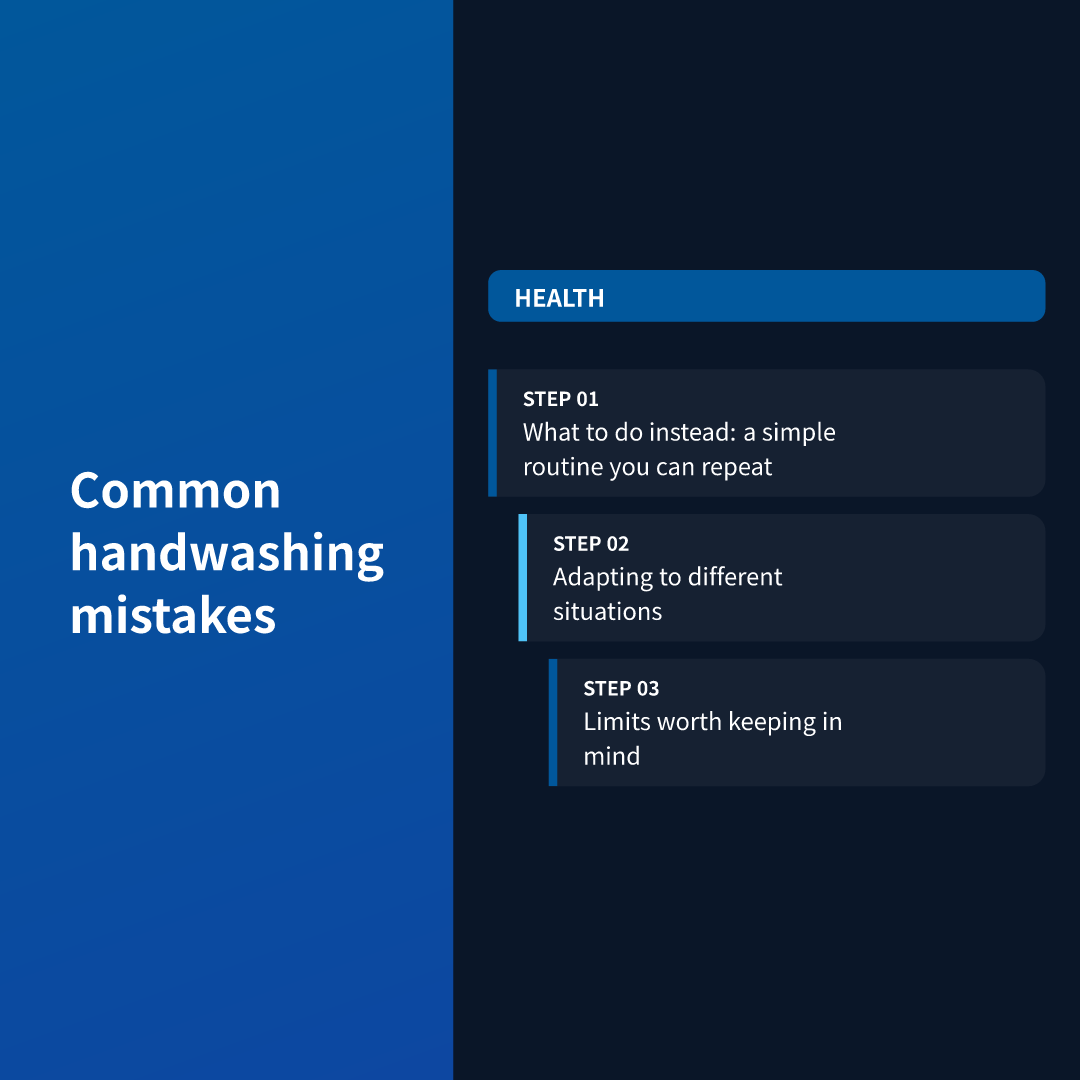
What to do instead: a simple routine you can repeat
Once the common errors are out of the way, the corrected routine is short enough to become automatic. The steps below follow the general approach described by the CDC and WHO.
- Wet your hands with clean running water. Temperature is mostly a comfort choice, and warmer water is not generally considered more effective at removing germs.
- Add soap and lather up, making sure the foam reaches the backs of your hands, between your fingers, and under your nails.
- Scrub for about twenty seconds, which is roughly the time it takes to hum a familiar song twice through.
- Rinse thoroughly under clean running water so soap residue does not stay on your skin.
- Dry with a clean towel or air dry them completely.
That is the whole thing. It is not complicated, and honestly the hardest part is doing it consistently, not learning it. Pairing it with moments you already do, like coming through the door at home, can make it stick.
Know the moments that matter most
Washing constantly is not necessary, and over-washing can leave skin dry and irritated. The CDC's general guidance highlights key moments when handwashing is especially helpful:
- Before, during, and after preparing food
- Before eating
- After using the bathroom
- After changing a diaper or helping a child in the bathroom
- After blowing your nose, coughing, or sneezing
- After touching garbage
- After handling pets, pet food, or pet waste
- Before and after caring for someone who is sick or treating a cut or wound
If that list feels long, focus on the first few. Food and bathroom moments are the ones most people agree on, and the rest can follow once the habit is established.
Adapting to different situations
Real life does not always offer a clean sink and a roll of paper towels. A few common scenarios call for a bit of adjustment.
When you are out and there is no sink
Hand sanitizer with enough alcohol is generally described by the CDC as a reasonable option when soap and water are not available. It works best on hands that are not visibly dirty. As soon as you reach a sink, washing with soap is the better choice. Check the product label for how to use it, and ask a pharmacist if you are unsure about a product.
When you are cooking
Kitchens are a spot where handwashing matters a lot, particularly after handling raw meat, poultry, seafood, or eggs. Washing between tasks, not only at the start and end, helps avoid moving germs from raw ingredients to foods that will not be cooked further. Public food safety agencies, including the USDA and FDA, emphasize this in their general guidance.
When you are caring for young children
Kids often rush or skip steps, and they tend to copy what adults do. Making it playful helps: songs, a favorite soap, or a step stool so they can reach the sink comfortably. Adults can wash alongside them so the technique becomes familiar. Babies and toddlers who cannot wash on their own can have their hands wiped or washed by a caregiver.
When someone at home is sick
Households with a sick person benefit from extra attention to handwashing, along with a few practical habits like using separate towels and cleaning frequently touched surfaces. This does not guarantee that others will avoid getting sick, but it can be part of reducing spread. If symptoms are severe or worrying, it is worth contacting a healthcare professional.
When your skin gets dry or irritated
Frequent washing, especially in colder or drier seasons, can leave hands feeling tight, rough, or cracked. Many people find that a gentle, fragrance-free soap and a hand moisturizer after washing feel more comfortable, though individual skin reactions vary. If your hands become painfully cracked, red, itchy, or start to bleed, that is worth discussing with a pharmacist, doctor, or dermatologist, because damaged skin can be harder to keep clean and may need specific care.
When you have a job that requires frequent washing
People who work in healthcare, food service, childcare, or cleaning often wash many times a day. Skin protection becomes part of the routine, and workplace guidance may add specific steps. Employers and occupational health resources can provide advice tailored to your role, and a doctor can help if skin problems persist.
Limits worth keeping in mind
Good handwashing is a helpful habit, not a shield. It can reduce the chance of passing along or picking up certain germs, but it does not replace other protective steps like staying home when ill, staying up to date with recommended vaccines, and following food safety practices. Some germs are also more resistant to the removal that soap and water provide, and individual health conditions can change how much risk a person faces.
People with weakened immune systems, those caring for newborns, and anyone with a chronic skin condition may need more tailored advice. If you fall into one of those groups, a clinician or pharmacist can help you decide what hygiene routine fits your situation. And if you notice signs of infection on your skin, such as spreading redness, warmth, swelling, or pus, or you develop a fever, seek medical care rather than relying on home routines.
Frequently asked questions
Does the water need to be hot for handwashing to work?
No, hot water is not generally considered necessary. Public health agencies such as the CDC describe water temperature as mostly a comfort choice, since the soap and scrubbing do most of the work. Very hot water can irritate skin, especially if you wash often.
Is antibacterial soap better than regular soap?
Not necessarily. Many people wonder whether over-the-counter antibacterial washes are any better than plain soap and water, and a pharmacist or clinician can help you decide what suits your needs. Plain soap used with proper scrubbing is generally considered a sound everyday choice, and a pharmacist can answer questions about specific products.
Is it really worth the effort if I wash my hands a lot already?
Yes, because frequency and technique are two different things. Someone can wash many times a day and still miss fingertips, thumbs, or the backs of the hands, or rinse before soap has had time to work. Tightening up the technique, rather than washing more often, is usually the more useful adjustment, and it also helps avoid unnecessary skin dryness.
To sum up, knowing how to wash hands properly is less about doing something new and more about correcting a few small habits: use soap, take your time, cover every part of your hands, rinse well, and dry completely. Results and risks vary from person to person, so if you have skin concerns or health conditions that affect your routine, a pharmacist or doctor is the right person to ask.
Disclaimer: This article is for informational purposes only and is not a substitute for professional medical advice, diagnosis, or treatment. Please consult a licensed professional for personal health decisions.